SimMock
SimMock API
The SimMock API provides interfaces for the development of CMocka Tests with a representative mocked implementation of the ModelC <-> SimBus interface. The mock supports a Signal Vector (scalar) and Network Vector (binary). Several models may be loaded into the SimMock.
Component Diagram
@startuml simmock-objects

title SimMock Objects

package "SimBus Mock" {
    class Signal <<SignalVector>> {
        +uint32_t count
        +double scalar[]
        +annotation()
    }

    class Network <<SignalVector>> {
        +uint32_t count
        +bool is_binary
        +void* binary[]
        #NCODEC* ncodec[]
        +annotation()
        +append()
        +reset()
        #codec()
    }

    file svSig [
    signalgroup.yaml
    ....
    kind: <b>SignalGroup
    metadata:
    name: <b>signal
    labels:
        channel: <b>signal_vector
    ]

    file svNet [
    signalgroup.yaml
    ....
    kind: <b>SignalGroup
    metadata:
    name: <b>network
    labels:
        channel: <b>network_vector
    annotations:
        vector_type: <b>binary
    ]

    Signal -> svSig
    Network -> svNet
}

map ModelMock {
    sv_signal *--> Signal
    sv_network *--> Network
}

map SimMock {
    model *--> ModelMock

    sv_signal *--> Signal
    sv_network_rx *-> Network
    sv_network_tx *-> Network
}

center footer Dynamic Simulation Environment

@enduml
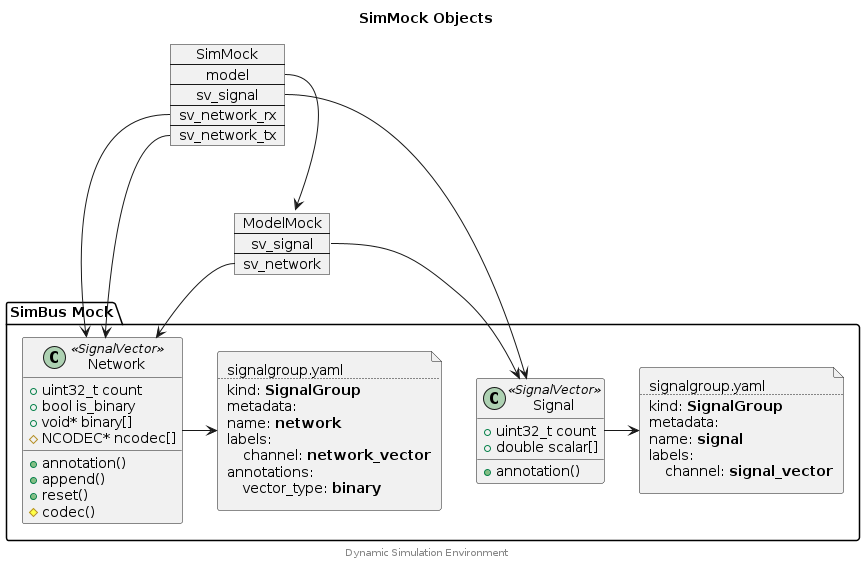
Typedefs
BinaryCheck
typedef struct BinaryCheck {
    int index;
    int* buffer;
    int len;
}
FrameCheck
typedef struct FrameCheck {
    int frame_id;
    int offset;
    int value;
    bool not_present;
}
ModelMock
typedef struct ModelMock {
    const char* name;
    int* mi;
    int* sv_signal;
    int* sv_network;
    int* sv_save;
    int vtable;
    int* sm_signal;
    int* mfc_signal;
}
SignalCheck
typedef struct SignalCheck {
    int index;
    double value;
}
SimMock
typedef struct SimMock {
    int sim;
    double step_size;
    ModelMock* model;
    void* doc_list;
    double model_time;
    int* sv_signal;
    int* sv_network_rx;
    int* sv_network_tx;
}
Functions
simmock_alloc
Create a SimMock object.
Parameters
- inst_names[] (const char*)
- Array of model instance names which should be allocated in the SimMock object.
- count (size_t)
- The number of elements in the
inst_namesarray.
Returns
- SimMock*
- The allocated SimMock object. Caller should free by calling
simmock_free().
simmock_binary_check
Check the content of a binary signal.
Parameters
- mock (SimMock*)
- A SimMock object.
- model_name (const char*)
- The name of the model to check.
- checks (BinaryCheck*)
- Array of BinaryCheck objects.
- count (size_t)
- The number elements in the checks array.
- func (BinaryCheckFunc)
- Optional function pointer for performing the binary check.
simmock_configure
Configure a SimMock object with a list of command line arguments (as would be used by the ModelC.exe).
Example
{{< readfile file="../examples/simmock_configure.c" code="true" lang="c" >}}
Parameters
- mock (SimMock*)
- A SimMock object.
- argv (char*)
- Array of arguments.
- argc (size_t)
- Number of elements in the
argvarray. - expect_model_count (size_t)
- The expected number of models to be configured (based on the parsed list of arguments).
simmock_exit
Call model_destroy() for each model.
Parameters
- mock (SimMock*)
- A SimMock object.
- call_destroy (bool)
- Indicate that model_destroy() should be explicitly called. Set to
truewhen using the SimMock library outside of the ModelC repo (which has its own mock object representing the controller).
simmock_find_model
Find a MockModel object contained within a SimMock object.
Parameters
- mock (SimMock*)
- A SimMock object.
- name (const char*)
- The name of the model to find.
Returns
- MockModel*
- The identified MockModel object.
- NULL
- No MockModel was found.
simmock_frame_check
Check the content of a binary signal for various frames. The binary signal should be represented by a Network Codec (NCodec) object.
Example
{{< readfile file="../examples/simmock_frame_check.c" code="true" lang="c" >}}
Parameters
- mock (SimMock*)
- A SimMock object.
- model_name (const char*)
- The name of the model to check.
- sig_name (const char*)
- The name of the binary signal where frames should be located.
- checks (FrameCheck*)
- Array of FrameCheck objects.
- count (size_t)
- The number elements in the checks array.
simmock_free
Destroy and free resources allocated to a SimMock object.
Parameters
- mock (SimMock*)
- The SimMock object to be released.
simmock_load
Load all of the models referenced by a SimMock object.
Parameters
- mock (SimMock*)
- A SimMock object.
simmock_load_model_check
Check the condition/state of a loaded model.
Parameters
- mock (SimMock*)
- A SimMock object.
- expect_create_func (bool)
- Indicate that model libraries should contain a
model_createfunction. - expect_step_func (bool)
- Indicate that model libraries should contain a
model_stepfunction. - expect_destroy_func (bool)
- Indicate that model libraries should contain a
model_destroyfunction.
simmock_print_binary_signals
Print the binary signals contained in each network vector of each model.
Parameters
- mock (SimMock*)
- A SimMock object.
- level (int)
- The log level to print at.
simmock_print_network_frames
Print the frames contained in each network vector of each model.
Parameters
- mock (SimMock*)
- A SimMock object.
- level (int)
- The log level to print at.
simmock_print_scalar_signals
Print the scalar signal values of each signal vector of each model.
Parameters
- mock (SimMock*)
- A SimMock object.
- level (int)
- The log level to print at.
simmock_read_frame
Read a frame, using the associated NCodec object, from the specified binary signal.
Parameters
- sv (SignalVector*)
- A Signal Vector object.
- sig_name (const char*)
- The name of the binary signal where frames should be written.
- data (uint8_t*)
- Array for the read data. The data is preallocated by the caller.
- len (size_t)
- Length of the data array.
Returns
- uint32_t
- The Frame ID associated with the read data.
- 0
- No frame was found in the specified binary signal.
simmock_read_pdu
Read a PDU, using the associated NCodec object, from the specified binary signal.
Parameters
- sv (SignalVector*)
- A Signal Vector object.
- sig_name (const char*)
- The name of the binary signal where PDUs should be written.
- data (uint8_t*)
- Array for the read data. The data is preallocated by the caller.
- len (size_t)
- Length of the data array.
Returns
- uint32_t
- The PDU ID associated with the read data.
- 0
- No PDU was found in the specified binary signal.
simmock_setup
Calls the model_setup() function on each model and then creates Signal Vectors
for each model. Additional Signal Vectors are created to facilitate the
mocked behaviour of a simulation (via the SimMock object).
Parameters
- mock (SimMock*)
- A SimMock object.
- sig_name (const char*)
- The name of the scalar channel.
- sig_name (const char*)
- The name of the binary channel.
simmock_signal_check
Check the values of various signals on the Signal Vector (scalar).
Example
{{< readfile file="../examples/simmock_signal_check.c" code="true" lang="c" >}}
Parameters
- mock (SimMock*)
- A SimMock object.
- model_name (const char*)
- The name of the model to check.
- checks (SignalCheck*)
- Array of SignalCheck objects.
- count (size_t)
- The number elements in the checks array.
- func (SignalCheckFunc)
- Optional function pointer for performing the signal check.
simmock_step
Calls model_step() on each model and manages the mocked exchange of both
scalar and binary Signal Vectors.
Parameters
- mock (SimMock*)
- A SimMock object.
- assert_rc (bool)
- Indicate that an assert check (value 0) should be made for each return
from a call to
model_step().
Returns
- int
- The combined (or'ed) return code of each call to
model_step().
simmock_write_frame
Write a frame, using the associated NCodec object, to the specified binary signal.
Parameters
- sv (SignalVector*)
- A Signal Vector object.
- sig_name (const char*)
- The name of the binary signal where frames should be written.
- data (uint8_t*)
- Array of data to write (in the frame).
- len (size_t)
- Length of the data array.
- frame_id (uint32_t)
- The Frame ID associated with the data.
- frame_type (uint8_t)
- The Frame Type associated with the frame.
simmock_write_pdu
Write a PDU, using the associated NCodec object, to the specified binary signal.
Parameters
- sv (SignalVector*)
- A Signal Vector object.
- sig_name (const char*)
- The name of the binary signal where PDUs should be written.
- data (uint8_t*)
- Array of data to write (in the PDU).
- len (size_t)
- Length of the data array.
- id (uint32_t)
- The PDU ID associated with the data.